
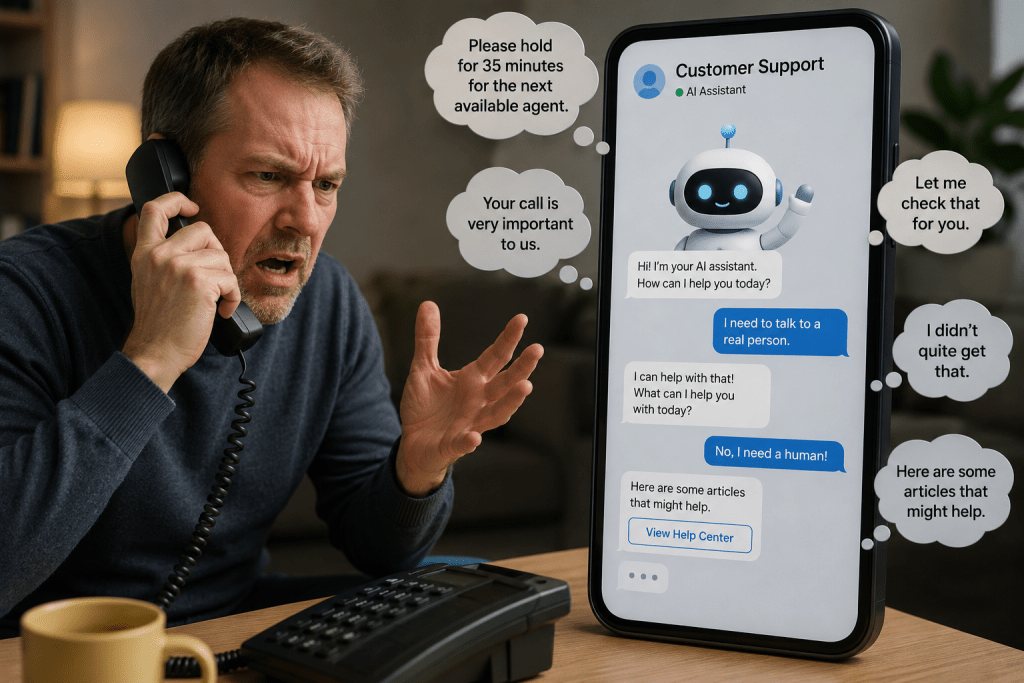
I’ve been intrigued lately with conversations I’ve been having with people dealing with AI in customer service. It’s a challenge. My virtual ears perked up particularly when I read that New Orleans, Seattle, and Atlanta, to name three, are using AI to answer 911 calls.
In these cases, it seems like the technology may help to triangulate locations and dispatch help with great efficiency, but as this article says, it’s not all there yet.
I’ve also been talking to people about their use of AI, and several companies came in for a great deal of criticism, AAA for example was unable to help a caller stuck by the road because the AI system wasn’t able to understand what was needed—and it couldn’t transfer the caller to a human. This particular person had to do it old school: he flagged down another car to come to his assitance
Now, it’s clear that this is an isolated incident, and perhaps others have had better experiences, but those don’t help our stranded friend. However, I collected other stories of people being unable to get past the bots to solve problems, bots not programmed to address unique issues, and broken bots that didn’t answer questions and left callers feeling stranded. (On the other side of the coin, companies like Spectrum and GoDaddy got high marks for their systems—and the ability to get to a real and helpful person.)
The challenge with AI customer service, though, is that a bad experience can be damaging to a brand, and we all know that folks are more likely to take to social media to complain than to praise. So, as we head into Q4 and the holiday season, it’s highly likely that customer service lines at toy companies may start buzzing soon.

It’s not that AI should be avoided. In fact, various studies we reviewed on this were pretty consistent: customers aren’t inherently against AI in support—they’re against AI that traps them. Frustration doesn’t come from AI existing in support; it comes from AI becoming a barrier between the customer and an actual resolution. A bot that handles a password reset in ten seconds is a win. A bot that stands between a stranded driver and a tow truck, as described above, is a liability—and exactly the kind of story that drives cancellations, as you’ve found.
A few best practices keep coming up and I talk to folks trying to integrate AI into their customer service systems:
1. Always leave a visible door to a human. Companies need a seamless, easy path for customers to escalate from AI to a human agent—not hidden behind menus or “let me try that again” loops. The AAA case is a textbook failure of this: roadside assistance is inherently time-pressured and sometimes safety-critical, so hiding the human option is close to indefensible.
2. Detect frustration and escalate proactively, don’t wait for a workaround. If a customer repeats themselves or uses language indicating anger, that should trigger human intervention automatically, rather than requiring the customer to find “the trick” to reach a person. For instance, several people we talked to said, they just kept repeating “agent” or “representative” until the bot responded.
3. No re-explaining. When AI escalates, the human agent should receive full context — conversation history, inferred intent, and attempted actions—because asking customers to restate their issue is a CX failure. This is probably the single most-cited complaint across the research: people don’t mind AI, they mind starting over.
4. Match the tool to the stakes. Routine, low-emotion tasks (order status, FAQs, password resets) are great AI territory. Billing disputes, outages, or genuinely upsetting problems call for human empathy—and canned AI sympathy often makes things worse. Just imagine a mom on Christmas morning upset because a toy doesn’t work while it looks like Santa has delivered a lemon. You get the idea.
5. Use failures as feedback. Unanswered questions and escalations should feed back into knowledge updates and policy tuning rather than being treated as noise.
AI can work for customer service. However, AI should absorb volume, not gatekeep urgency. Companies that get this backwards—as AAA apparently did for one drive—end up spending goodwill faster than they save on headcount.
