

By Joseph A. Farco, Esq. of Farco ToyCo LLC and Norris McLaughlin P.A
As a toy inventor himself, Joe has an extensive experience in advising clients on intellectual property in the toy and gaming space. Joe advises clients on different IP protection methods, such as obtaining the right type of patent on your toy, copyrights and trademarks for different types of toy branding, and licensing and manufacturing deals involving the same. Joe also provides guidance to clients seeking to enter the toy space or produce a particular toy but want to be respectful of the IP rights of others.
How Many Bells and Whistles do you need? – The Art of Toy Patent Disclosure
Around the globe, there appears to be a consensus that if you want a patent on your toy, you have to provide enough details in the patent to enable skilled toy designers to make and use the creation. The claim of protection in the patent correlates to the amount and type of disclosure you choose to use. In other words, the more you disclose the more you have available to claim and protect.
In many jurisdictions, you do not need to disclose what is already well-known. See In re Buchner, 929 F.2d 660, 661 (Fed. Cir. 1991). However, by leaving out details or variations of your idea, you forfeit the ability to use those details/variations to overcome prior art or possibly capture those variations with your patent claims.
The following is one example to illustrate some things to consider in your toy patent preparation endeavors.
EXAMPLE: Confectionary Commandos, Kitchenators, and Mangia Monsters
Toy Inventor 1 is the maker of CONFECTIONARY COMMANDOS, which are action figure toys that use previously existing candies as part of their accessories to do battle and go on adventures. To save money, Toy Inventor 1 tells his patent attorney to only write a patent application to cover his specific version of the Confectionary Commandos:
[1] United States – 35 U.S.C. §112(a) (“The specification shall contain a written description of the invention, and of the manner and process of making and using it, in such full, clear, concise, and exact terms as to enable any person skilled in the art to which it pertains, or with which it is most nearly connected, to make and use the same….”; Australia – Section 40(2) of the Australian Patents Act (“disclose the invention in a manner which is clear enough and complete enough for the invention to be performed by a person skilled in the relevant art… .”); Canada – Section 27(3) of the Canadian Patent Act (“(a) correctly and fully describe the invention and its operation or use as contemplated by the inventor; (b) set out clearly the various steps in a process, or the method of constructing, making, compounding or using a machine, manufacture or composition of matter, in such full, clear, concise and exact terms as to enable any person skilled in the art or science to which it pertains, or with which it is most closely connected, to make, construct, compound or use it.”); China – Article 26.3 of the PRC Patent Law and PRC Patent Examination Guidelines (specification must “i) clearly disclose the technical solution of the invention; ii) describe in detail the embodiments for practicing the invention; and iii) completely disclose any necessary technical information for understanding and practicing the invention to such extent that a skill person is enabled to practice the invention.”); European Patent Convention (EPC) – Art. 83 (patent application disclose the invention in a manner sufficiently clear and complete for it to be carried out by a person skilled in the art.)

Toy Inventor 2 sees Confectionary Commandos in the marketplace and works with a patent attorney to design his/her own new type of food toy called Kitchenators. Toy Inventor 2 has not yet made any of his toys, but he/she have an idea of the possibilities. Toy Inventor 2 works with a patent attorney who has a background in toys to help him/her expand upon their Kitchenators idea and cover various different versions and options that could be used (including ones that might be too expensive for Toy Inventor 2 to ever make itself). The patent attorney discloses the following in Toy Inventor 2’s patent application, some of which is identical to subject matter in the patent application for Toy Inventor 1 (items A and B):
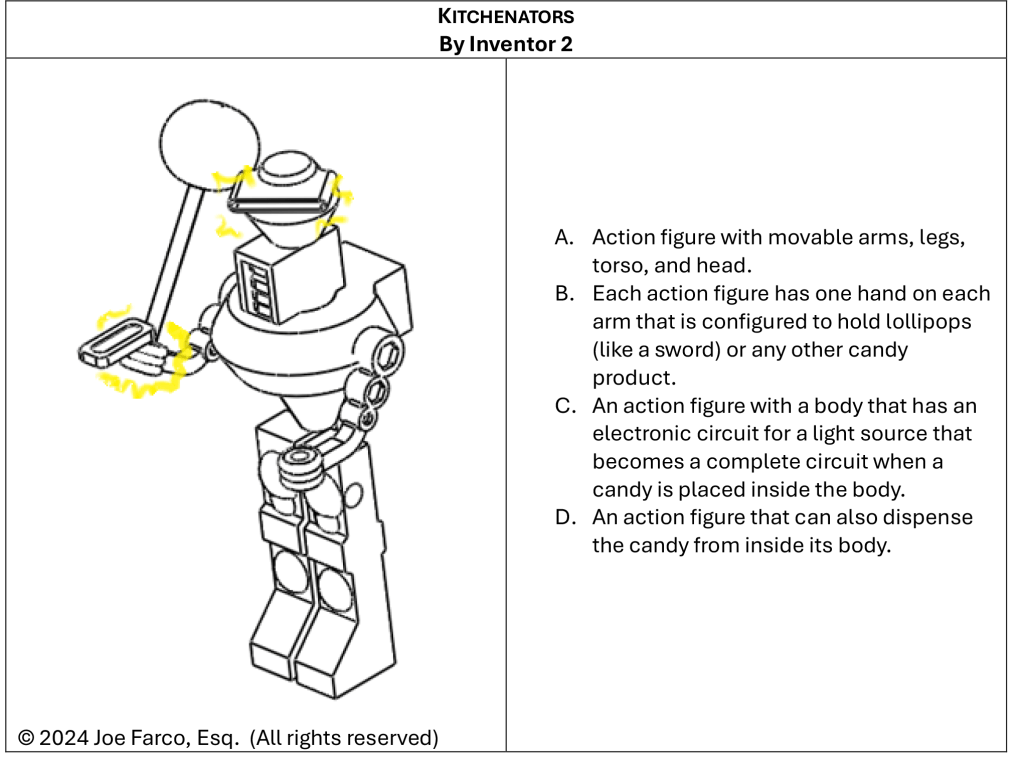
Unbeknownst to Toy Inventor 1 and Toy Inventor 2 (but not to the patent examiner), a now-defunct toy business in Italy made a product line called Mangia Monsters five years ago. Mangia Monsters were action figure toys that had hands that can hold forks, spoons, and popsicle sticks.

Scenario 1: A Limited Toy Patent Disclosure Limits the Toy Patent Protection
When Toy Inventor 1 goes to get a patent on the Confectionary Commandos, the patent attorney puts the following claim before the United States Patent and Trademark Office (“USPTO”) (and other foreign patent offices):
Claim 1. A toy product comprising:
– a figure body; and
– at least one movable appendage coupled to the figure body, the at least one movable appendage configured to frictionally hold a candy.
During examination of the patent application, the USPTO cited Mangia Monsters as prior art because it disclosed toys that had an action figure body with hands that can hold popsicle sticks. To amend the claim 1 to get around Mangia Monsters, the patent attorney for Toy Inventor 1 is forced to use the limited disclosure he has to amend Claim 1 to make it patentable over Mangia Monsters. The patent attorney amends Claim to make it specific to holding lollipops because Mangia Monsters toys only hold popsicle sticks.
Claim 1 (Amended). A toy product comprising:
– a figure body; and
– at least one movable appendage coupled to the figure body, the at least one movable appendage configured to frictionally hold a candy lollipop.
The USPTO rejects Claim 1 again on the basis that a lollipop is an obvious variant of a popsicle. Without any disclosure to show a difference between a lollipop and a popsicle, the patent attorney for Toy Inventor 1 is forced to find something else in the disclosure to make Claim 1 different from Mangia Monsters. Since Claim 1 as amended includes items A and B, the only choice the patent attorney has left is to include item C in Claim 1:
Claim 1 (Amended). A toy product comprising:
– a figure body;
– at least one movable appendage coupled to the figure body, the at least one movable appendage configured to frictionally hold a lollipop; and
– a light source disposed in the at least one movable appendage that illuminates when the lollipop is held by the at least one movable appendage.
The USPTO grants Toy Inventor 1 a patent based on the latest amendment by the patent attorney (which we call “Patent 1”). However, Claim 1 of Patent 1 requires more features than when it started off at the time of filing, i.e., it is narrower in scope.
While the patent attorney tells Toy Inventor 1 that Patent 1 “covers” the Confectionary Commandos, legally, Claim 1 covers a very specific version of Confectionary Commandos. In other words, competitors who do not make this very specific version of Confectionary Commandos can evade infringing Patent 1. This unfortunate reality could have been avoided had the disclosure of Patent 1 been more detailed to afford the patent attorney more ways to avoid the Mangia Monsters prior art and get a broader claim for Toy Inventor 1 to protect the Confectionary Commandos toy line.
Scenario 2: Limited Toy Patent Protection means More Legal Competition
Confectionary Commandos is doing well in the market place. One day, Toy Inventor 1 finds out at the New York Toy Fair that there will be a new toy line coming out next month called Kitchenators, which are action figures that hold lollipops in their hands as well as do a bunch of other things. Toy Inventor 1 is very angry and demands his attorney sue Kitchenators for patent infringement. Toy Inventor 1’s patent attorney explains that Patent 1 only excludes others from making, using, selling, offering for sale, or importing the subject matter in its issued Claim 1, which is reproduced below:
Claim 1. A toy product comprising:
– a figure body;
– at least one movable appendage coupled to the figure body, the at least one movable appendage configured to frictionally hold a lollipop; and
– a light source disposed in the at least one movable appendage that illuminates when the lollipop is held by the at least one movable appendage.
Because the Kitchenators toys do not have light sources in their arms that light up while they hold lollipos, like the Confectionary Commandos, they cannot infringe Claim 1 of Patent 1. Toy Inventor 1 is forced to deal with the Kitchenators entering the marketspace as a competitor against its pre-existing Confectionary Commandos. This is another unfortunate by-product of a very narrow disclosure on the part of Toy Inventor 1.
Scenario 3: A Limited Toy Patent Disclosure Causes Lost Toy Patenting Opportunities
As if learning nothing can be done to stop competition by Kitchenators, Toy Inventor 1 learns that a new patent has been granted to Toy Inventor 2 related to the Kitchenators toy line (“Patent 2”). Patent 2 has the following claim:
Claim 1. A toy product comprising:
– a figure body having at least at least one movable appendage, wherein the figure body is configured to frictionally hold and mechanically release at least one type of confectionary product and the at least one movable appendage is configured to frictionally hold another type of confectionary product; and
– a light unit disposed in the figure body that illuminates when the at least one type of confectionary product interconnects a power source to the light unit while disposed within the figure body.
First, Toy Inventor 1 is angry that Claim 1 of Patent 2 has some of the same subject matter as the claim in his patent. His patent attorney explains that the common subject matter (action figure and hands that hold lollipops) is not proprietary to anybody and is available for anyone to claim because the USPTO found it adequately in existence through Mangia Monsters in the prior art.
Second, Toy Inventor 1 cannot understand how Kitchenators are using light sources on the action figure, but just not in the arms. Again, the patent attorney explains that the disclosure of Patent 2 provides a wealth of detail of how this light source operates with the candy placed into the body – detail that is not in Patent 1.
Deciding he has to keep up with Kitchenators, Toy Inventor 1 contemplates changing the Confectionary Commandos so that they can light up when you put a candy in their bodies. The patent attorney rightly warns Toy Inventor 1 that such a change would infringe Claim 1 of Patent 2. Even though Confectionary Commandos came out first, the idea for a light up figure body that lights up from placing candy inside it was disclosed by Toy Inventor 2 first.
This is another lesson where the one that discloses more gets more.
Scenario 4: The Larger the Toy Patent Disclosure, the More Toy Patenting Opportunities
Knowing that he cannot infringe Patent 2, Toy Inventor 1 does not see any product in the market that is like Kitchenators or Confectionary Commandos that also dispenses candy from the body. Toy Inventor 1 does not know that Toy Inventor 2 does not have the resources to make such products, and so Kitchenators is limited to what has been offered at this time. Seeing an opportunity to further distinguish Confectionary Commandos from Kitchenators, Toy Inventor 1 engages his manufacturer, pays for molds, does market research, and begins selling his new version of the Confectionary Commandos with a toy dispensing feature in the body. Commercial success follows Toy Inventor 1’s efforts.
His patent attorney comes to him and brings to him a cease and desist letter attaching a Patent 3, which is another patent belonging to Inventor 2. Patent 3 has the following Claim:
Claim 1. A toy product comprising:
– a figure body having at least at least one movable appendage, wherein the figure body is configured to frictionally hold and mechanically release at least one type of confectionary product and the at least one movable appendage is configured to frictionally hold another type of confectionary product; and
– an opening in the figure body to allow mechanical dispensing of the candy stored therein.
Inventor 1 wants to call up Inventor 2 to ask how he thinks he can get money for an idea he never made or invested the time or effort to produce and market. Inventor 1’s patent attorney correctly explains to Inventor 1 that Inventor 2 never needed to make the subject matter sufficiently disclosed in Patent 3 that is now claimed. Since skilled toy designers understood how to injection mold action figures and dispense candy, the disclosure of a candy dispenser in the body of the action figure was sufficient to enable skilled toy designers to make such a variation using routine skill. While Inventor 1 pointed out that Patent 3 did not disclose how Inventor 1 makes the candy-dispensing mechanisms in the Confectionary Commandos he sells, the patent attorney explained that the Claim 1 of Patent 3 is not limited to how a person makes the final product, and any method of known manufacture could be used.
While able to avoid Patent 2, Inventor 1 failed to research Patent 2 and Patent 3 to determine whether Inventor 2 preserved alternative embodiments that could later be claimed and infringed. Inventor 1’s lack of due diligence in reviewing his competitor’s patents is very costly mistake in that it has led to allegations of patent infringement and sunk costs of molds, marketing, and manufacturing that might have otherwise been avoided. In this way, Inventor 2’s extra disclosures that were eventually claimed in Patent 3 served as a trap to Inventor 1 and enables Inventor 2 to now get royalties for a product it never had to mold, market, or manufacture itself.
CONCLUSION
The lack of details in the disclosures of Patent 1 led to it being far less valuable to Inventor 1 and any potential investors because of the narrow protections it afforded to the Confectionary Commandos toy line. In contrast, Patent 2 and Patent 3 enabled Inventor 2 to protect the version of Kitchenators it sold as well as potential options for the toy line that it, or its competitors, may try to use in the future. To an investor, Patent 2 and Patent 3 are a more valuable patent portfolio asset because they offer a variety of ways to make money while providing protection against competition to the Kitchenators toy line.


