

Innovation is incremental. Yes, there’s the notion that a new idea will come like a bolt from the blue and upend the toy industry—and sometimes it does. Yet, when a breakthrough product bursts out of the gate, such as a smoking cauldron that lets you “make” your own magical pet, or, in the case of one of the coolest products at the Convention Centre, a puzzle/model that lets kids look inside a book to see its world come to life; it’s usually the result of a confluence of factors. There are advances in technology, materials, and manufacturing techniques, all of which evolve over time and set the stage for innovation.
Of course, all of that is only technique until it rubs up against creative genius. (And we’ll define genius as the ability to think about something in a new way.) When a designer or a company gets to the point of asking “what if…?” with all the joy and curiosity of child, that’s when magic happens, and it can draw on all of these other evolving elements.

Walking the halls of the Hong Kong Toys & Games Fair, of course one sees tons of conventional product, mostly basics: whether preschool items, R/C, role play, or this year’s hot item—gel blasters.
It’s worth taking a moment to distinguish between “trendy” and “transformative.” Trendy is important as the toy industry, at least since the 1950s, has always been opportunistic, capitalizing on (often fleeting) popularity and making hay while the sun shines, so to speak. This year, as noted, it’s gel blasters—and some of the targets and ways to play with them are very, very cool. Last year, it was monochromatic infant and preschool toys. That teether has been well chewed: we only found two companies selling those this year. Traditional preschool colors are back, and that ballyhooed trend, which was never anything other than opinion and a media blip anyway, proved to have limited market power.

Transitional, on the other hand, are elements that may not yet have found ideal expression in a toy, but bear watching—and just waiting for a creative application. We saw a few things that made us stop, think, and being to imagine:
Miniaturization—Nothing new in the toy industry. Miniatures have always had an appeal. What appears new is the level of performance and sophistication that some of the new motors, lights, and sound production could make possible, not to mention cost savings. Where can this go beyond R/C?
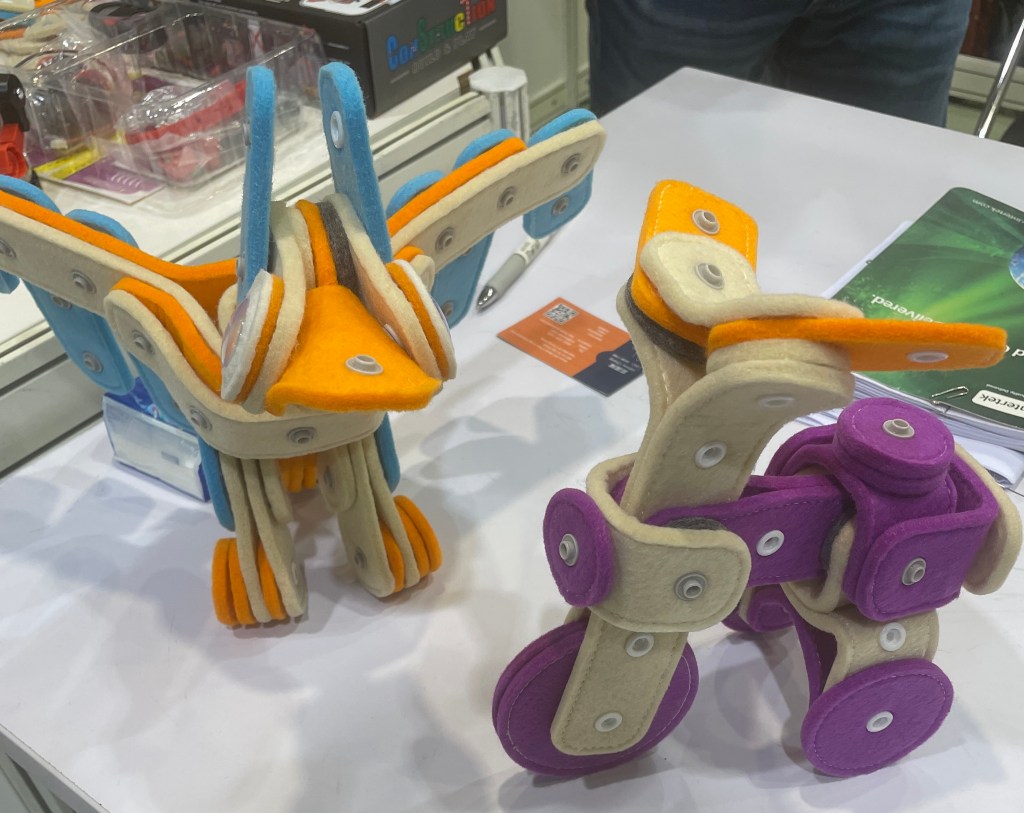
Design—Over the past several years, we’ve been impressed at the growing design sensibility of companies here, particularly from the Chinese Mainland. One of the areas that is particularly impressive is rethinking construction, moving away from brick-based systems and rethinking scale and play pattern. Not to mention discovering that “beige for baby” may not have been the sine qua non of infant toy design moving forward.
Licensing—Also not new. However, over the past twenty years, it’s been interesting/encouraging to see how companies here have embraced legitimate licenses, which in turn has opened some creative floodgates. From new form factors, to surprising applications, to manufacturing processes that allow cost-effective, higher margin products, innovation is often backstage…but impactful.
AI—It is way too early to determine how AI will impact the mass market toy business. (We’ll have things to say about some of the “predictions and applications” we heard bandied about later on.) However, we found some companies making first attempts. Seeing those firsthand is informative and potentially inspiring.
Seeing what’s out there remains one of the most informative elements of a trade show. That sounds glaringly simplistic, but it is a bit surprising that more toy company reps weren’t walking the floors this year. After all, who knows where that next innovative idea is coming from?
What do you think?
