
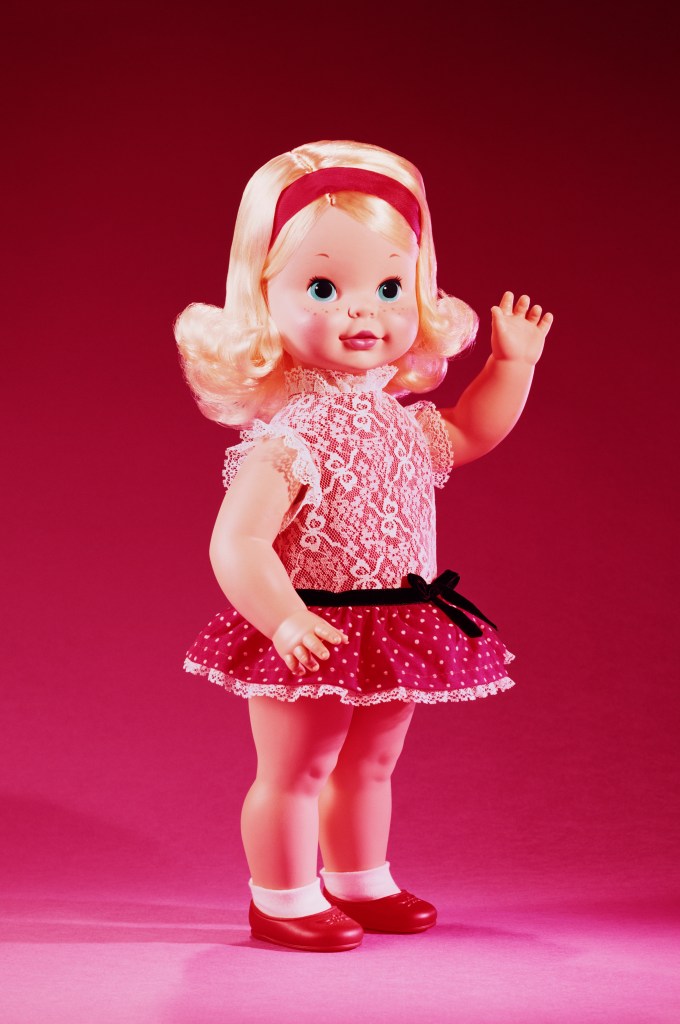
In 1959, the talking doll was not a completely new phenomenon. There had been dolls that said “Ma Ma” when they were turned over. (A version of the classic “Cow in a Can” toy.) There had been dolls that had a version of a phonograph record in them, back in the 19th century when records were still cylindrical. Thomas Edison even got involved in making them. They didn’t work very well, and they cost a whopping $10 (about $250 in 2012).
Chatty Cathy, however, was the first, successful, working and mass-market talking doll. Unlike her predecessors, she could be picked up and played with while she talked. Chatty Cathy was chatty indeed, and said an unprecedented 11 different things, a feature that was touted in the doll’s commercial. She worked with a pull string, and the unit inside her was essentially a small record that would access any of the saying randomly. Her phrases, which were considered quite long at the time, included, “Let’s play house.” “Please change my dress.” “Tell me a story.” And, of course, that staple phrase of talking dolls, “I love you.”
Cathy’s original voice was recorded by June Foray, who was also the voice of Rocky the Flying Squirrel in The Adventures of Rocky and Bullwinkle. (When Mattel reintroduced the doll in the 1970s, the voice was provided by none other than Maureen McCormick— known to a new generation of kids as Marcia Brady from The Brady Bunch. McCormick appeared in commercials for the doll as well.)
The talking feature proved so popular that in 1962 Mattel introduced Singing Chatty Cathy and expanded the family with big sister Charmin’ Chatty and little sister Chatty Baby.
But Chatty and her sisters did more than merely talk. They were also tremendously popular fashion dolls. Over the years of her popularity, her very chic wardrobe was continually expanded, and Mattel made versions of the doll with different hair and eye colors, and even an African American version.
What Happened?
Chatty Cathy was one of the most popular dolls of all time. She was a top-selling doll from 1959 through 1965. During the early to mid-1960s, she had a lot of competition. Ideal’s Betsy Wetsy and Tiny Tears were big sellers, and gimmicks such as growing hair and magically appearing make-up, giving rise to what today is called, at least in the toy industry, “the feature doll.”
But the real competition for Chatty Cathy came from two opposite ends of the beauty spectrum. For sheer beauty, Barbie, which had also been introduced in 1959, had created a new kind of fashion doll play where the dolls interacted with one another, rather than just with the child as Chatty Cathy did. And with a look that could only be described as “different,” Trolls were a huge fad. Both of these edged out Chatty Cathy and the larger feature dolls.
Where Are The Toys Now?
Chatty Cathy dolls can still be found online and in antique shops. As dolls go, she has a small but loyal collector following. It’s very rare to find a Chatty Cathy that still talks, however. Whether the pull string gave out and broke with time or the rubber band that drove the record in her speech unit disintegrated over time, Cathy may still look good but she hasn’t a lot to say.
In today’s world, all kinds of toys talk. We have no idea how AI is going to transform talking toys in the future. We’re not there yet, but one of these days, the dolls are going to be yakking up a storm.
Even as loquacious as they are, they can’t approach the excitement of pulling Chatty Cathy’s string and waiting to see what amazing thing she’d say next.
Featured image: Courtesy Ira Gallen TV Days.
Based on Toy Time: Look Back at the Most-Beloved Toys of Decades Past by Christopher Byrne
