
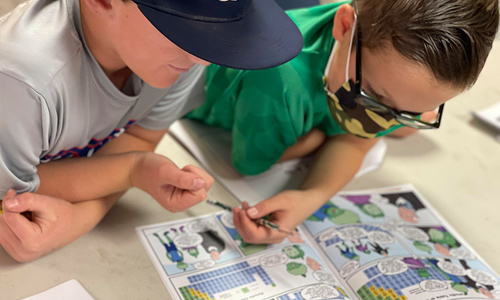
Colleen Kelley, Ph.D. is the Creator and Founder of Kids’ Chemical Solutions (www.kidschemicalsolutions.com) which is a comic-book based curriculum for students of all ages. Her journey as a chemist began at The University of Richmond where she received her B.S. in Chemistry. She fell in love with the world of discovery and research and wanted to continue to explore more chemistry, so she completed her Ph.D. in chemistry at Penn State University at the age of 24.
Fast forward 30 years later to the tail-end of her career teaching chemistry at the University of Arizona, Colleen finds herself captivated by the question, “Why do my students think chemistry is SO hard?” What she has discovered is that learning chemistry is very much like learning how to read and she created the term Molecular Literacy to describe how chemistry is best understood
After seeing inequities in science education throughout my 30-year teaching career, I decided to take a novel approach to solving this problem. I began writing comic books to help kids better understand the fundamentals of chemistry.
About half of college students who start out majoring in the sciences don’t finish those degrees. A 2020 study in the peer-reviewed journal found that students from all backgrounds enter college intending to major in a science field at the same rate. But underrepresented minorities’ low performance relative to their capabilities in required college chemistry courses contributed to their especially high attrition rates in science majors.


The age-old question for me continues to be…WHY are these students failing chemistry at such high rates?
My research uncovered an answer to this question. Fundamentally, learning chemistry is like learning to read and students entering college are, for the most part, molecularly illiterate. If you consider the Periodic Table the alphabet of science, formulas are the words of science, and chemical equations are sentences, then you can see strategically how both reading and chemistry follow the same paradigm for learning. What I discovered is the best time to teach kids chemistry is right after they have learned to read (ages 8+) so that they can use the same neural pathways and strategies to become Molecularly Literate.
Hence, I created this comic book series that scaffolds the learning objectives found in a 100-level college chemistry course to be used to teach chemistry to students ages 8+. I piloted this program for 14 weeks in a 4th grade classroom with 95% of the students mastering college chemistry concepts and NGSS standards. I now feel an urgency to increase Molecular Literacy on a global scale.
What Can You Expect? Learning Outcomes Achieved from The M.C. Detective Agency Curriculum
Well, the first things you can expect is to laugh out loud, have fun, and enjoy the process of learning chemistry! We have witnessed this first-hand while working with various homeschool families and in 4th-grade classrooms. The children (and adults!) love it! OK, OK, OK, we also know you want to understand the results from our research studies with these different groups of students.
Our most quantitative data comes from our 10-week study in 4th grade classrooms. The students completed the curriculum from File 1: The Case of the Deadly Dials and File 2: The Case of the Missing (Atomic) Model.
Dr. Kelley analyzed each student’s work:
- Students were prompted to write freely in their Reading Guides about what they were learning on each page as they read the comic book.
- Student’s Reading Guides were analyzed and coded in two categories: NGSS Standards and Chemistry Learning Outcomes.
- These pages were analyzed and coded for evidence of mastery, comprehension, or developmental levels.
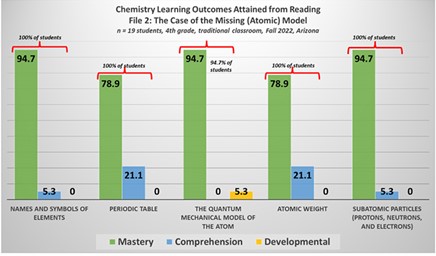
The chemistry learning outcomes were astounding! 95% of students displayed mastery of college-level concepts including those that are abstract (the Quantum Mechanical Model of an Atom) and quantitative (calculating atomic weights, protons, neutrons, and electrons).
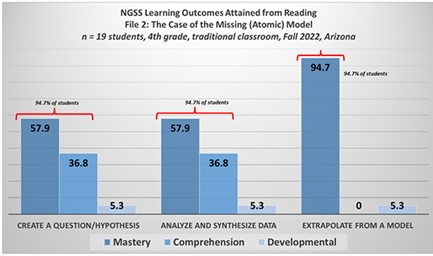
Assessment of NGSS learning outcomes showed that 95% of students exhibited mastery/comprehension of components of scientific thinking and analysis, e.g., creation of a question, analysis of data/evidence, and extrapolation from a model.
Why Is Molecular Literacy Essential?
Did you know that ~50% of students fail or drop a college chemistry course stopping them from pursuing over 50 majors?!?! Our research, combined with over 30 years of experience teaching at the college level, shows Molecular Literacy is the key to success in college chemistry courses.
