
For any giftgiver who has ever handed a kid a toy — any toy, from a $2 bath duck to a $200 robotics kit — there’s a very good chance they could trace its birth certificate back to one place: Chenghai, a district of Shantou, on the southern coast of China’s Guangdong province.
It’s an unassuming name for what is, in practical terms, the toy capital of the planet. Roughly 70% of all toys made in China come out of this single district. Given that more than 85% of the toys sold in the U.S. are made in China, that means a huge share of what fills American toy aisles — and Amazon carts, and stockings every December — has its roots in Chenghai’s dense grid of factories and showrooms.
A district built entirely around plastic, molds, and imagination
Chenghai’s rise wasn’t an accident. It grew out of decades of specialization: one street does injection molding, another does dyeing and printing, another handles packaging and assembly. That kind of hyper-local division of labor is why the region can spin up new toy lines quickly and cost-effectively—and why buyers who understand how to move through it may have a real advantage over those who don’t.
Some of the people we spoke to suggested that Shantou could be the “new Hong Kong,” and whether or not that’s true, a region that a century ago was characterized by poverty has become an attractive destination for many Chinese as the toy industry in the region continues to spur economic growth.
Industry estimates put Chenghai’s output at around a third of the world’s plastic toys and roughly half of China’s total toy production. Tens of thousands of toy-related businesses operate there, many of them small, specialized shops that plug into a much larger manufacturing organism. It’s less a factory town than an ecosystem—and like any ecosystem, it rewards people who know how to navigate it and can be genuinely confusing for outsiders parachuting in for a few days.
The catch: access has always been the bottleneck

Here’s the tension every U.S. toy buyer eventually runs into. The supply is there. The capability is there. What’s historically been missing is visibility—a clean, trustworthy, and efficient way to see who’s actually behind a product, verify a factory can do what it claims, and get compliance sorted before a shipment is halfway across the Pacific.
The traditional route looks something like: buyer → agent → trader → sales office → factory. Every one of those links adds a little more distance, a little more delay, and a little more uncertainty, about what you’re really getting, not to mention increased costs at every step of the process.
Enter ON TOP — a bet on cutting that chain down

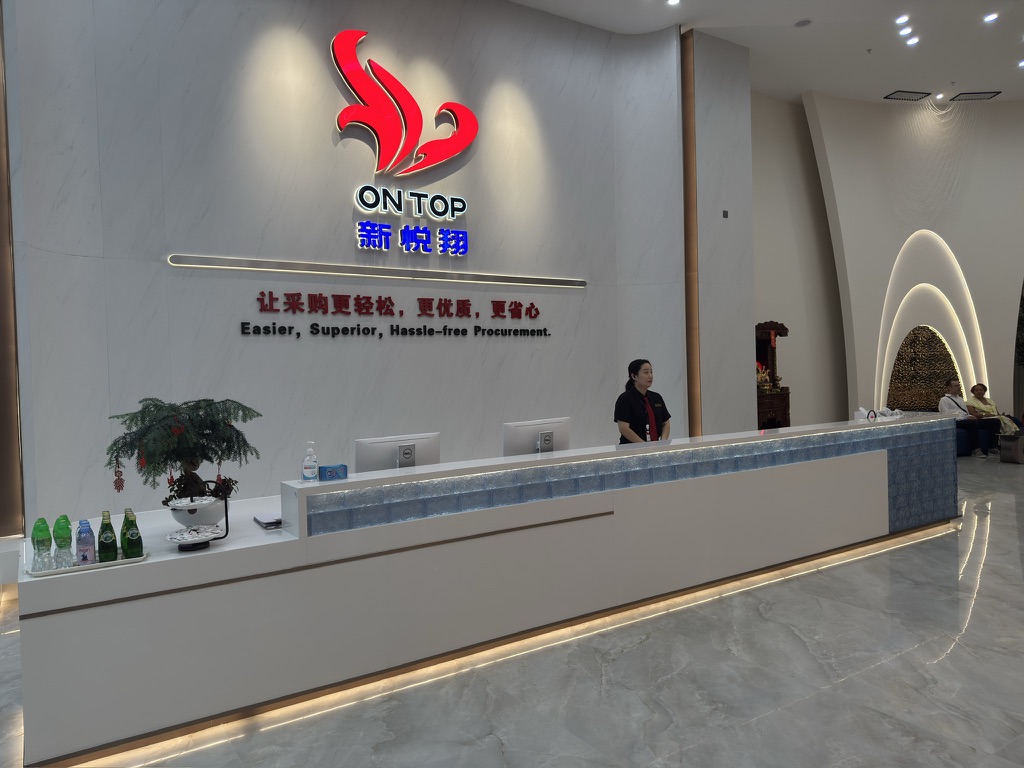
This is where a newer platform called ON TOP is poised to transform the sourcing and buying process in the region. Launched out of an 80,000 m² permanent B2B showroom in Shantou, ON TOP is essentially trying to build professional infrastructure around the region’s manufacturing base rather than adding another layer to it.
Recently, a group of international buyers, industry experts, and journalists were hosted on a trip to Shantou to experience the ON TOP platform firsthand. Global Toy News was the only U.S. representative on the trip.
The facility is impressive, gorgeous, and to be honest, a bit overwhelming for a first time visitor. And then when you consider that the entire building was constructed in approximately 20 months, it’s doubly impressive.
You can fit a lot of toys in 80,000 m². However with more than 340 full-time employees on the site, everything has been designed to make it accessible, easy-to-use and welcoming every step of the way. (More on the experience of shopping the showrooms below.)
The visit began with the group getting to know one another, and a sampling of Dancong tea, a signature tea of the Shantou region. It’s quite special, and indeed virtually every meeting began with the ritual of making and serving this unique tea—part of the warm hospitality of the entire operation.
During an opening presentation by Joe Qiao, global CEO for ON TOP, he laid out the vision and the operations of the organization as a major asset for the international toy industry. Some of the key points of ON TOP Qiao pointed out are:
- It’s not a trading company. ON TOP doesn’t take over ordering, contracts, payment, or shipment — those stay with the buyer’s existing agent or Beehub, ON TOP’s strategic partner. It’s positioning itself as the connective tissue, not another middleman.
- It leans on scale. The platform points to 10,000+ verified manufacturers and 500,000+ sourceable products under one roof, which is a meaningful shortcut for comparison shopping versus cold-emailing factories one by one.
- Compliance is baked in, not bolted on. Through a partnership with Intertek, ON TOP is trying to get testing, inspection, and certification expertise closer to suppliers — addressing things like EN 71 toy safety standards and REACH chemical requirements before products are halfway to market, not after a shipment gets flagged at customs.
- It treats sourcing as a relationship, not a trip. Beyond a one-time showroom visit, the digital platform (ontoptoys.com) is built to keep buyers connected to new arrivals, shortlists, and factory contacts long after they’ve left China.
Walking the floor…
A very natural question, certainly to someone like me, is how can one possibly make sense of nearly half a million toys? While I couldn’t possibly have seen everything on display, I saw a lot, and the shopping process for buyers is really remarkable. You can walk the expansive floors with a shopping cart, or, if you’re feeling adventurous, ride the battery operated scooters. (They’re fun, too.)
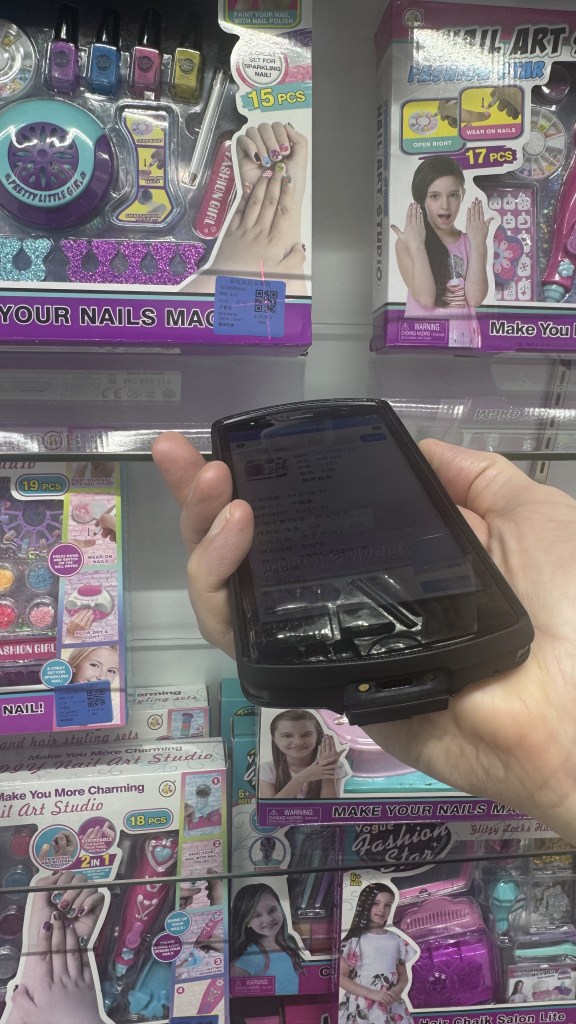
As a buyer tours the floor, a handheld device can scan products that are of interest, immediately bring up unit cost, specs, etc. This provides the foundation for future discussions, product refinements and potentially either the opening point of working with a specific factory or supplier or continuing a relationship.
The ease with which this happens—as well as the digital platform mentioned previously—begs the question of how this complement—or competes with—toy fairs. ON TOP is essentially a toy fair every day it’s opened. In a conversation with Qiao, he stressed the ability to stay connected as the toy business, particularly for many of the companies who show at ON TOP, is a year-round affair.
Oh, and according to ON TOP executives, the showrooms are sold out with a waiting list.
How ON TOP facilitates business for U.S. buyers

If your business already has a solid agent and a working relationship with Chenghai factories, none of this is urgen— you’ve solved the access problem the old-fashioned way, through years of trust-building.
But if you’re a smaller or growing U.S. toy brand trying to break into direct sourcing, or you’re tired of your product quality being only as good as your agent’s judgment, a platform like ON TOP is worth a serious look for a few concrete reasons:
- Faster factory vetting. Verified manufacturer networks cut down the guesswork of figuring out who’s legitimate versus who’s a trading company wearing a factory’s name.
- Compliance earlier in the process. With U.S. import scrutiny on toy safety only getting tighter, having testing and certification support engaged at the sourcing stage—not the shipping stage—is real risk mitigation.
- OEM/ODM flexibility. This issue was particularly important for many of the buyers I spoke with and toured the showrooms with. Many of them need and/or want a product built to spec rather than picked off a shelf, so direct access to manufacturers with the right production capability can shorten development cycles significantly.
- Lower “layers,” lower blind spots. Every link removed between a buyer and the actual factory floor is one less place for miscommunication, quality drift, or hidden costs to creep in.

Shantou isn’t going anywhere as a manufacturing center of gravity for the global toy industry. If anything, its infrastructure keeps compounding, and that will be critical as downward pressure on costs continue. The real question for U.S. buyers, then, isn’t whether to engage with the region, it’s whether to keep doing it the old way or start using the tools built to make that access cleaner, safer, and faster.
