

Fright and fun are the name of the game in these classic Halloween-themed board games that make family game night extra spooktacular.
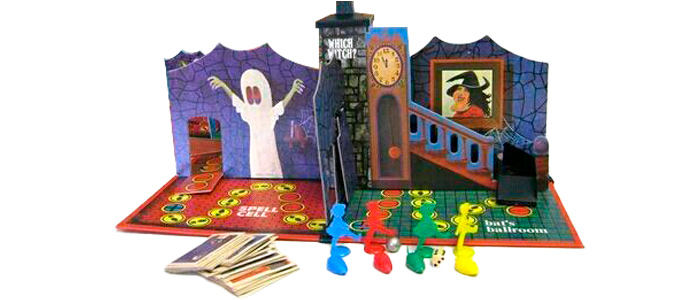
Which Witch?
Designed by Marvin Glass & Associates and distributed in North America by Milton Bradley, Which Witch challenges players to escape a haunted mansion. Released in 1970, the three-dimensional game board consists of four large rooms: the Bat’s Ballroom, the Broom Room, the Spell Cell, and my personal favorite, the Witchin’ Kitchen. A large chimney in the center of the board towers over the four rooms.
Players roll dice and draw cards to move from room to room. Each card represents one of three witches that live in the house—Ghoulish Gertie, Glenda the Good, and Wanda the Wicked. Depending on which witch a player draws, they may be enchanted by a spell, enticed to set off a booby trap, or have their spell broken. Booby traps are triggered by a Wanda the Wicked card, which causes a player to drop a “whammy ball” down the chimney stack.
The winner is the first player to navigate their way through these trials and tribulations to reach the safety of the Charmed Circle.

Them Bones
Mego’s Them Bones is like playing Milton Bradley’s Operation on a skeleton. Players must extract “tokens” from a skull placed in the middle of the board without touching any of the metal contacts. Inadvertently touching a contact causes a buzzer to sound or the skull’s red eyes to light up and setting the player back.
The tokens in Them Bones come in four types: a Ham Bone, Funny Bone, T-Bone, and Trombone. The first player to move all four of their tokens to the Home square in the middle of the board is declared the winner.
As an added challenge, Them Bones can be played in low light, as the skull, tokens, and spinner all glow in the dark.
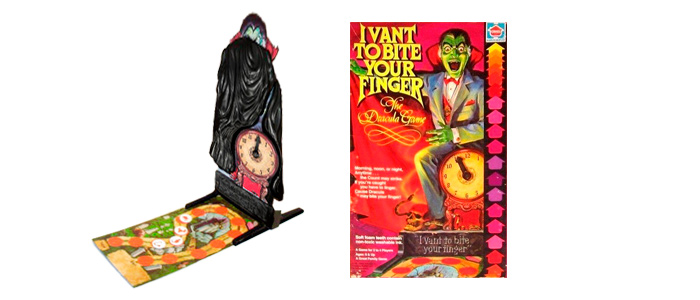
I Vant to Bite Your Finger
First published by Ideal and then Hasbro in the late 1970s, I Vant to Bite Your Finger features a plastic, mechanical version of Count Dracula that towers over the playing surface with the ability to “bite” players’ fingers. A clock with moveable hands is nested in the base of the Count.
Each turn sees players call out a number between 1 and 4 and move the hand on the clock that number of clicks in a clockwise direction. Here’s where the fun begins. If Dracula’s cape opens, he has been awakened and the player must put to put their finger in Dracula’s mouth while another presses down on the ridge behind his head. If two small red marks appear on the player’s finger (the “bite”, thanks to an ink pen), the player must return to the start.
The first player to escape the graveyard is the winner.
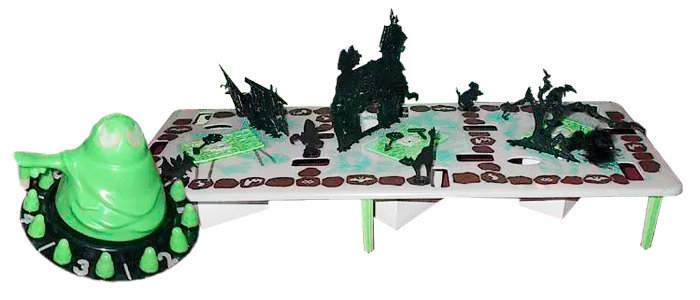
Green Ghost
Transogram’s Green Ghost hit store shelves in 1965 and was re-issued by Marx in 1997. It was marketed as “the luminous game you can play in the dark.” A glow-in-the-dark gameboard and phosphorescent playing pieces made gameplay extra spooky.
Green Ghost is the game’s protagonist, searching for his lost child, Kelly. Players take on the roles of Green Ghost’s pets charged with the search: a bat, cat, rat, and vulture. They move around the board, opening crypts and collecting ghost children. Meanwhile, Green Ghost directs their action by spinning around and making eerie sounds. The winner is the player representing the pet who finds Kelly.
The game’s design is quite clever, elevated on six legs with a series of crypts (cardboard boxes) placed underneath it. Three eerily designed backdrops include a shipwreck, a haunted house, and a gnarled tree.
Fright and Fun
Games like Which Witch?, Them Bones, I Vant to Bite Your Finger, and Green Ghost offer playful ways to explore spooky tropes like haunted houses, vampires, skeletons, and ghosts. They’re also a fun way to stay in the Halloween spirit long after trick-or-treating winds down.
Todd Coopee is Editor-in-Chief of Toy Tales, an online publication that covers toys and games past and present.
